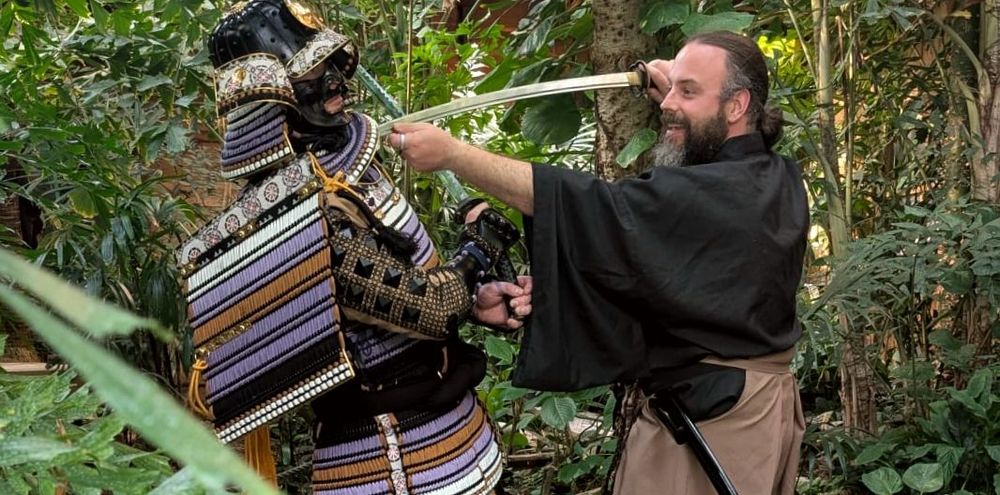
Today, Japanese sword fighting is often associated with elegant, flowing movements and fencing without armor. Historically, however, this was only part of the reality. There was a significant difference between unarmoured fencing (suhada kenjutsu 素肌剣術) and fighting in full armor, the so-called katchû kenjutsu (甲冑剣術).
Japanese armor - protection with a system
The classic Japanese armor, yoroi (鎧) or gusoku (具足), was not designed as continuous full-body protection. Instead, it followed a strategic principle:
Particularly vulnerable parts of the body were heavily armored, while other areas had only light or mobile protection. This design enabled mobility, but required a high degree of body control from the fighter.
In battle, the protective effect of the armor had to be specifically supported by positioning, distance control and a stable body posture (kamae 構え). Weak points should not be revealed - neither in attack nor in defense.
Armor as an active combat element
In Katchû Kenjutsu, armor was not only worn passively, but also used actively. Armored parts of the body could be used specifically to intercept, block or deflect an opponent's blows or thrusts.
The opponent in turn tried to break up this protective structure - for example by forcing unfavorable postures or by attacking unprotected zones.
For this reason, combat often took place at very close range. Typical techniques included the use of the yoroidōshi (鎧通), a dagger specially developed for penetrating armor, as well as half-sword techniques (soete-waza 添え手技), in which one hand grips the blade itself to achieve maximum control and precision.
Comparison with European armor
If you compare Japanese armor with the complete armour of the European late Middle Ages, around the time of the Hundred Years' War, there are clear differences.
A European knight was almost completely protected by his plate armor and would have had a technological advantage over a samurai of the Kamakura (鎌倉時代) or Azuchi-Momoyama (安土桃山) period in a direct duel.
However, this comparison falls short. Japanese war technology simply skipped this stage of development.
Technological change instead of evolutionary development
With contact with Spanish and Portuguese merchants, there was a direct transition in Japan from early and high medieval forms of combat to the warfare of the early modern period. Pike formations and matchlock rifles fundamentally changed the battlefield.
Similar developments in Europe led to the full armor becoming increasingly less important.
Fighting in armor, as taught in Katchû Kenjutsu, is therefore not a relic of a lack of technique, but an expression of a specific historical development - adapted to the conditions, weapons and tactical requirements of its time.